Sessions

2021 IA Conference

April 19, 2021

Beginner

This workshop is sold out.

More of our lives are happening online every day. We interact and transact through digital systems on a growing variety of devices. More understandable and coherent systems = better experiences. As a result, information architecture (IA) is more important than ever.

In this fast-paced workshop, you will:

  • Understand the primary goals of information architecture
  • Learn how people find and understand information
  • Learn to define conceptual models
  • Master necessary IA components
  • Identify essential IA collaboration skills
  • Learn how to communicate IA concepts
  • Discover how architectures evolve over time

Structure

This workshop has been a staple of the IA Conference for the past three years. Now, it's been wholly restructured for effective remote instruction.

The online workshop consists of three components:

  • Pre-recorded video lectures, which you can view on your own before real-time group activities
  • Real-time hands-on group exercises via Zoom
  • Asynchronous Q&A sessions via Discord

Lectures consist of our parts:

  1. Introduction to information architecture
  2. Conceptual modeling
  3. Basic IA components
  4. Basic IA skills

This new structure maximizes learning by making the most of our time together and makes it easier for distributed teams with busy schedules to participate.


Sign in now to access workshop resources.
Sessions

2021 IA Conference

April 22, 2021

Intermediate

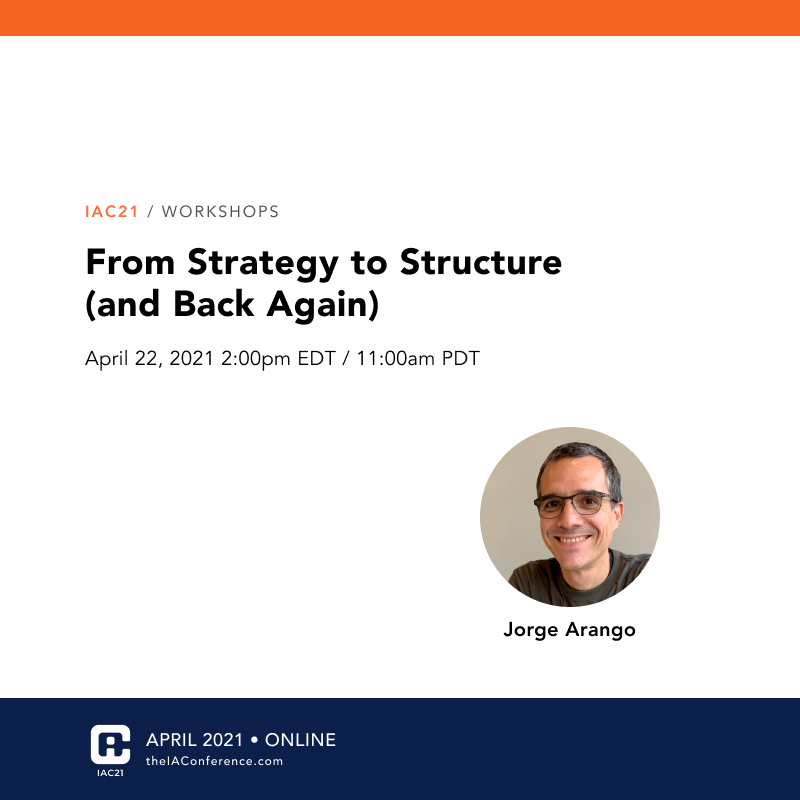
As a digital designer, you must think beyond the user interface to the underlying structures that give your systems coherence. These structures should serve the needs of your users, your organization, and society. To do so, you must understand your organization's strategic directions. This fast-paced workshop introduces strategic thinking for designers.


Sign in now to access workshop resources.
Sessions

2021 IA Conference

April 20, 2021

Intermediate

This workshop is sold out.

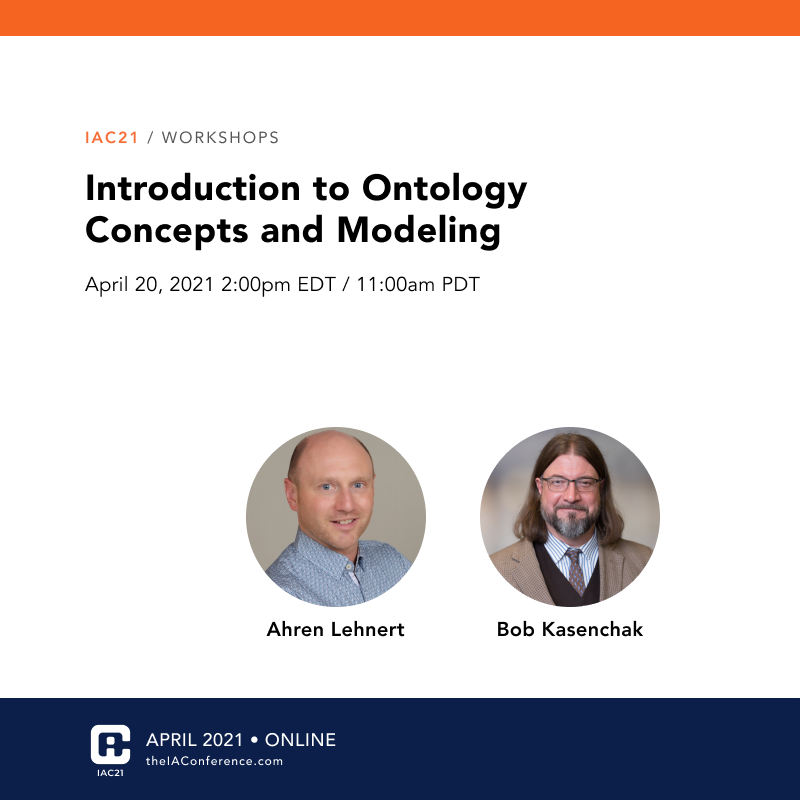
Are you interested in learning more about ontologies but don't know where to begin?

Our "Introduction to Ontology Concepts and Modeling" workshop comprises a three-hour introduction aimed at IAs who are interested in ontologies and would like to learn the basics, including:

  • Complex knowledge organization schemes and concept structures
  • Basics of ontological relationships
  • Information on existing ontologies for re-use
  • The difference between upper and lower ontologies
  • Basic ontology concepts like RDF and semantic triples
  • Software systems and components
  • Ontology modeling exercises

The session will be recorded and made available to registered attendees.

Sign in now to access workshop resources.
Download slide deck

https://vimeo.com/540513638

Sessions

2021 IA Conference

April 23, 2021

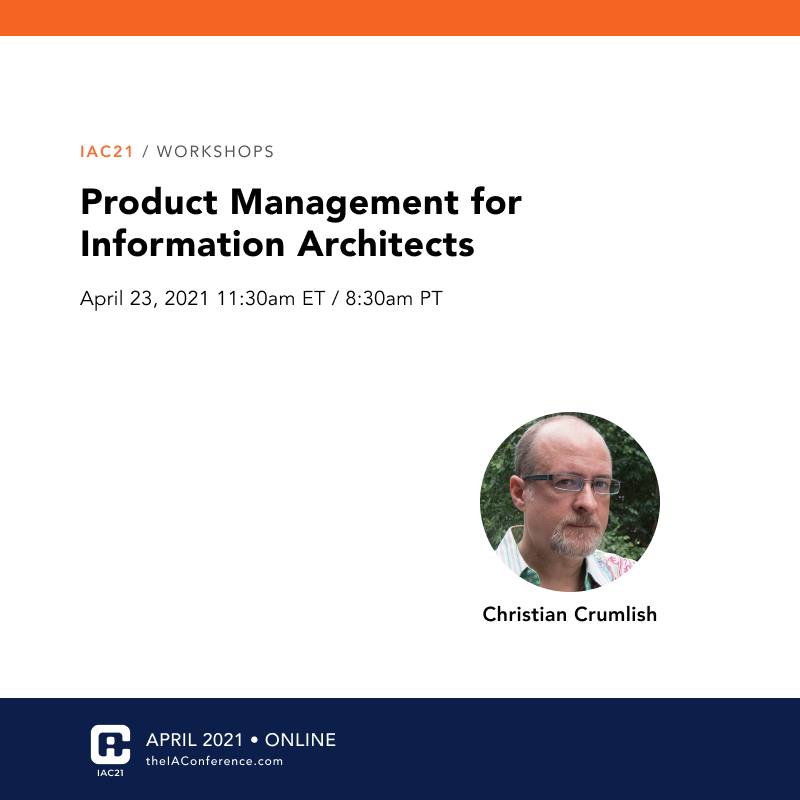
IA experience is wonderful preparation for product management, but the role of a product manager involves mastering additional skills related to software development, engineering, technical architecture, finding product-market fit, going to market, funnel optimization, revenue modeling, experimenting with hypotheses, managing products through lifecycles, sunsetting features, saying no to stakeholders, getting teams into alignment, and more.

In this workshop, Christian will explain how IA skills provide a great foundation for product management work, and then provide the basics and pointers for how to develop the complementary skills (such as those mentioned above) to qualify for product leadership roles.

Sign in now to access workshop resources.

Sessions

2021 IA Conference

April 20, 2021

Beginner, Intermediate

When people want to locate and discover information, they can simply type keywords into a search engine (not only Google) and select items from the first page of search results, right? This is the current mental model of how search/retrieval works for most users of all ages.

Sense-making is a searcher behavior that information architects, user experience (UX) and usability pros should not ignore. Search listings not only should make sense to individuals, they should also make sense to groups of people.

This workshop will answer the following questions:

  • Which parts of a search listing must make sense to people before they will click (or tap) on a link?
  • Where does sense-making occur during different parts of a search task?
  • What do common search systems use for display in search listings?
  • Does the type of search query affect the type of information that must make sense in search listings? (Short answer: yes!)
  • Do document owners have complete or limited control over how search listings appear?
  • How can we architect search listings so that they make sense for multiple target audiences?

Downloadable materials included. Workshop also includes a Sense-Making & Search Clinic to address your most pressing architecture questions.

The session will be recorded and made available to registered attendees.


Sign in now to access workshop resources.